What is the engineering process like, and how do you calculate (the capacity of) a heat exchanger?
A well-designed heat exchanger starts with a thorough analysis of the process. During the engineering process, we collect data on, amongst other things, flow rates, temperatures, pressures, media, contamination factors and available installation space.
Based on this, our engineers carry out thermal and mechanical calculations to select or design the optimal heat exchanger. In doing so, they take into account, amongst other things:
- heat transfer;
- pressure drop;
- fouling;
- flow velocities;
- choice of materials;
- service life and maintenance.
The following values are used in the formula below to calculate a suitable heat exchanger. The client’s engineers will need these values.
Formula: Q = F x Cp x dT
- Q = power (W)
- F = flow rate (kg/s)
- Cp = specific heat (J/kg°C)
- dT = T_in – T_out (°C)
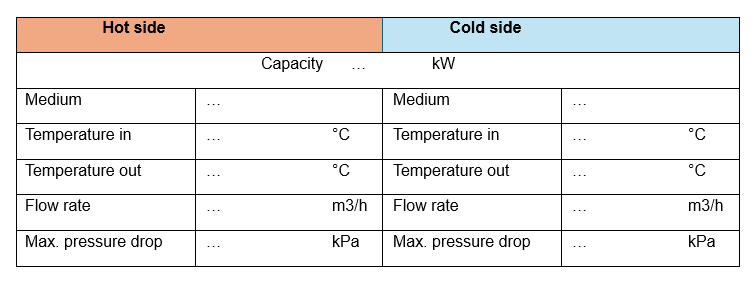
Depending on the parameters, we use advanced thermal design software and validated calculation methods to accurately calculate the heat exchanger. This ensures that you receive a design that meets both the process requirements and the applicable standards.