
Transforming an unreliable heat exchanger into a reliable one using HTRI Xvib
HTRI Member Success Story – Kapp Nederland
Imagine you have a reboiler that keeps on failing every few years by battle fretting.
Even when you double the number of baffles, it remains unreliable.
The root cause is most likely flow induced vibration. A tough challenge that we tackled using HTRI Xvib.
An unreliable reboiler
A chemical end-user was operating a kettle type reboiler to generate MP steam from high temperature oil effluent stream. The bundle of the reboiler was failing every 2-3 years by battle fretting. The baffles would cut into the tube causing it to leak. It was suspected to be caused by flow induced vibration.
Adding more baffles
The client had tried to solve the issue by doubling the number of baffles in the boiler to increase the tube natural frequency. By doing this they reduced the unsupported span length from 1000mm to 500mm. Despite this sounding better, it did not solve the issue. The reboiler remained unreliable.
Vibration analysis
The client started looking into alternative baffle designs. In the process of this, our engineers came in to help. We decided to apply vibration analysis, because the root cause was most likely from flow induced vibration. This analysis can be tricky for kettles because of its unpredictable two-phase (liquid-vapor) crossflow but using HTRI Xist we were able to implement it.
Confusion
HTRI Xist showed a tube natural frequency of 170 Hz, which is sufficient and should not be susceptible to vibration. Then, we used HTRI Xvib and it showed a frequency of 20 Hz which is radically different. This is considered low and susceptible to vibration damage.
One step closer to a solution
HTRI Xvib handled the U-bend well, which is why we ended up with 20 Hz. This purpose-built HTRI 3D FEM vibration analysis model is specifically built to do one thing: predict whether fluid forces will cause heat exchanger tubes to fail due to vibration. It is also particularly strong at accurately determining the tube natural frequency using Finite Element Methods.
A Eureka moment
The client originally tried to fix the vibration by doubling the number of baffles. But the tubes still had a dangerously low natural frequency of 20 Hz.
We were confused as to why the software programs gave completely different answers, which led to a realization about how a single tube behaves according to the different softwares.
It is important to realise that a single tube has one natural frequency. It is one continuous piece of metal anchored at the tubesheet, running through several baffles, looping around the U-bend, and coming back. The longest unsupported length of that continuous tube (the dominant span) dictates the natural frequency of the entire tube. The overall bundle diameter was 1500 mm, which meant the curved U-bend sticking out at the end was about 2500 mm (2.5 meters!) of unsupported tube. The straight parts of the tubes between the baffles were already spaced closer than 2500 mm. Doubling the baffles made the straight sections stiffer, but it did absolutely nothing to fix that massive 2.5-meter U-bend at the end. The dominant span was still 2500 mm, so the tube’s natural frequency stayed stuck at 20 Hz.
The final solution
We had to change the physics of this U-bend to get it to function correctly.
Instead of adding more useless baffles in the straight section, we added two specialized supports directly inside the U-bend at 45-degree angles in Xvib and re-calcuated the natural frequency.
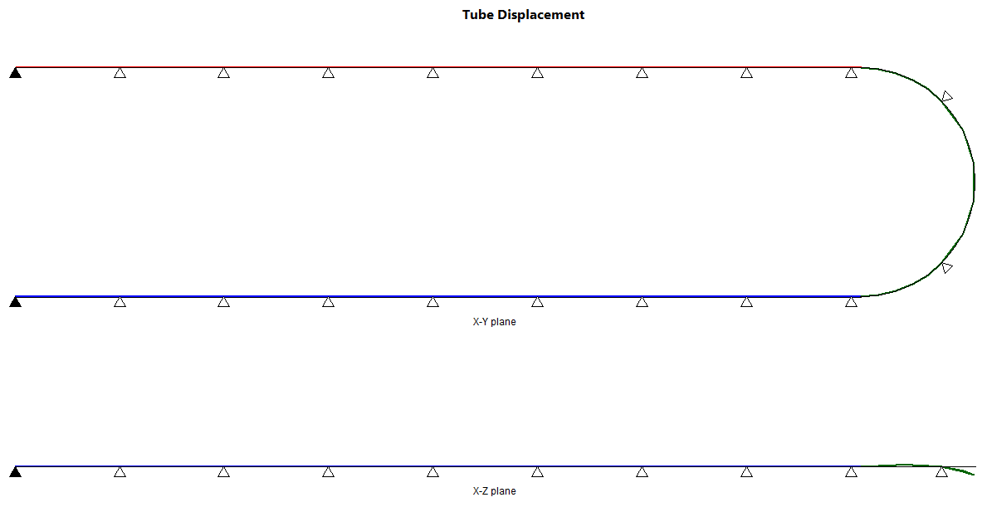
By getting rid of the original dominant span, the natural frequency skyrocketed from 20 Hz to 140 Hz. A higher natural frequency means the tube is incredibly stiff and requires vastly more fluid energy to vibrate than the reboiler could ever produce.
It became immune to the fluid forces. The bundle was fabricated according to the latest Xvib simulation with 500 mm baffles spacing and 2 U-bend supports.
It’s been 10 years, and this bundle is still in operation without any failing tubes.
HTRI Xvib allowed us to make a skilled analysis of the root cause and supported optimization of the design. The end-user is no longer affected by a poorly performing heat exchanger, risk of leakage and expenses (and CO2 emissions) from periodic replacement.