
Compact condensers for an additives supplier
For a new production facility belonging to a supplier of additives, a practical question was: how can we reliably condense solvent vapours whilst space is limited?
Seeking a compact solution
Kapp was asked to contribute ideas regarding the design of the condensers. From a thermal perspective, the solution naturally had to meet the process requirements. At the same time, there was only limited space available above the tanks, where the heat exchangers had to be physically installed.
The initial calculations highlighted the challenge. A tubular heat exchanger approximately three metres long would be suitable from a thermal point of view, but its dimensions meant it would take up too much vertical space above the tanks. It was therefore necessary to find a way to achieve the same heat transfer in a considerably more compact design.
From vapour to condensate
The condensers are used in a production process in which nitrogen, solvent vapours and other VOCs (Volatile Organic Compounds) are released whilst the tanks are being filled. During filling, air is displaced from the tanks. This air contains vapours from which we wish to remove as many VOCs as possible before they are discharged into the environment.
This is where the condensers come in: by cooling the vapour stream, the solvent vapours present condense and can be recovered as a liquid. The condenser thus functions as part of the emission control system.
A shell-and-tube heat exchanger has been selected for this application. A key advantage of this design is the large flow-through surface area within the tubes. This makes it possible for the condensed liquid to flow downwards in the opposite direction to the gas flow. This is known as the reflux effect: as the vapours move through the tubes, some of them condense and the condensate flows back downwards.
The challenge was then not only to condense the VOCs, but also to ensure sufficient heat transfer within the limited space available above the tanks.
Turbulators as the key to a more compact design
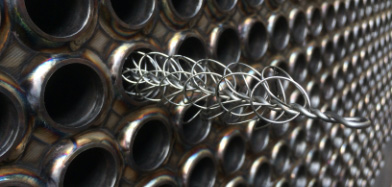
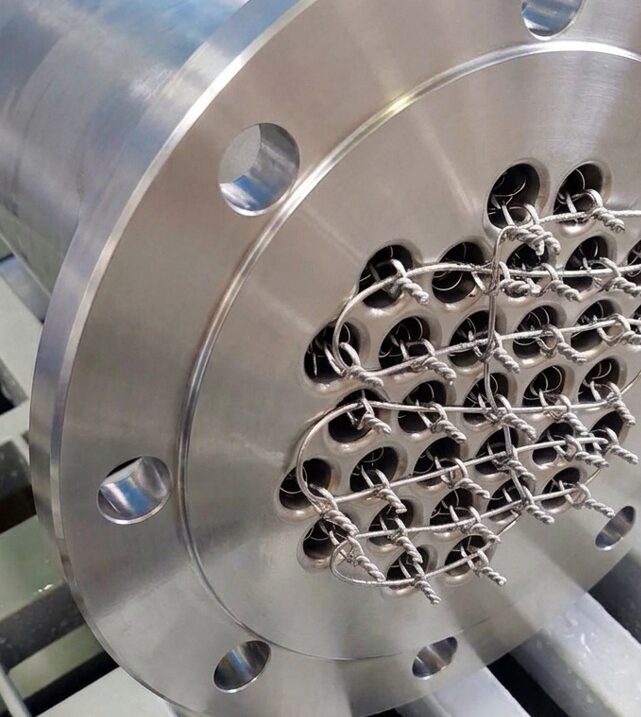
Kapp investigated various options for increasing heat transfer without simply adding more heat-exchange surface area. The solution was found in an HRS tube heat exchanger fitted with Calgavin wire mesh turbulators in the tubes. This wire mesh serves two purposes in this application.
1. Increased contact and agglomeration of mist droplets
The wire mesh creates additional opportunities for contact between the mist droplets present. This allows smaller droplets to come into contact with one another and agglomerate. Whilst the effect is not comparable to that of a full-scale demister, the turbulators do help to promote the coalescence of condensate within the pipe.
2. Greater turbulence, better heat transfer
In addition, the turbulators create more movement in the fluid. The turbulence and vortices cause the thermal boundary layer along the tube wall to be repeatedly disrupted. This brings the fluid into closer contact with the wall, allowing more heat to be transferred. It is precisely this additional heat transfer that made it possible to design the heat exchanger considerably shorter, without losing capacity.
From three metres to 70 centimetres
Thanks to the modified tube configuration and the wire mesh turbulators, the design could be significantly shortened. Whilst the initial design called for a tube length of approximately three metres, a heat exchanger measuring just 70 centimetres was ultimately realised. This resulted in a solution that provided sufficient heat transfer to condense the VOCs in the displaced air and also fitted within the limited headroom available above the tanks. This enabled the condensers to fulfil their role in emission control without taking up an unnecessary amount of space in the new production facility.
Smart engineering
This case study shows that a more compact design does not always mean compromising on heat transfer. Sometimes, the solution lies precisely in making better use of the existing heat-exchange surface. By specifically influencing the flow and condensation within the tubes using wire mesh turbulators, Kapp was able to achieve the required performance in a considerably more compact design. The final heat exchangers were approximately three times lighter than the original design. This not only makes them easier to handle and transport but also means that less metal is required to fulfil the same function.