
A chilling challenge: heating propane with seawater
How do you heat liquid propane from −43.2 °C to −5 °C safely, in a controlled way, and without unnecessary energy use? A major international player in oil and gas storage approached Kapp with this question. For years, their installation had relied on a conventional steam boiler fired by natural gas. Reliable, but expensive, and with CO₂ emissions that increasingly conflicted with the company’s ambitions. The objective was clear: it had to be more sustainable, safer, and more efficient, without compromising operational reliability. Kapp developed a solution that brought these ambitions together and achieved a CO₂ reduction of no less than 75%.
A sea of energy
Liquid propane at −43.2 °C requires extremely precise heating. Heating it too quickly or unevenly is not an option. Safety is always the top priority. Electric heating initially seemed like a logical solution, but grid limitations made it impractical. On top of that, both investment and energy costs would increase significantly. So the question was reframed: Could it be done differently? Smarter? Using resources already available? The answer was literally right on the doorstep: seawater.
No combustion, but heat: The switch to seawater
Kapp designed a system that uses seawater as a heating medium, a source that is continuously available at no cost. No combustion, no flue gas discharge, but a cleverly utilized heat difference. The process consists of two carefully coordinated steps.
Step 1: Seawater as a sustainable energy source
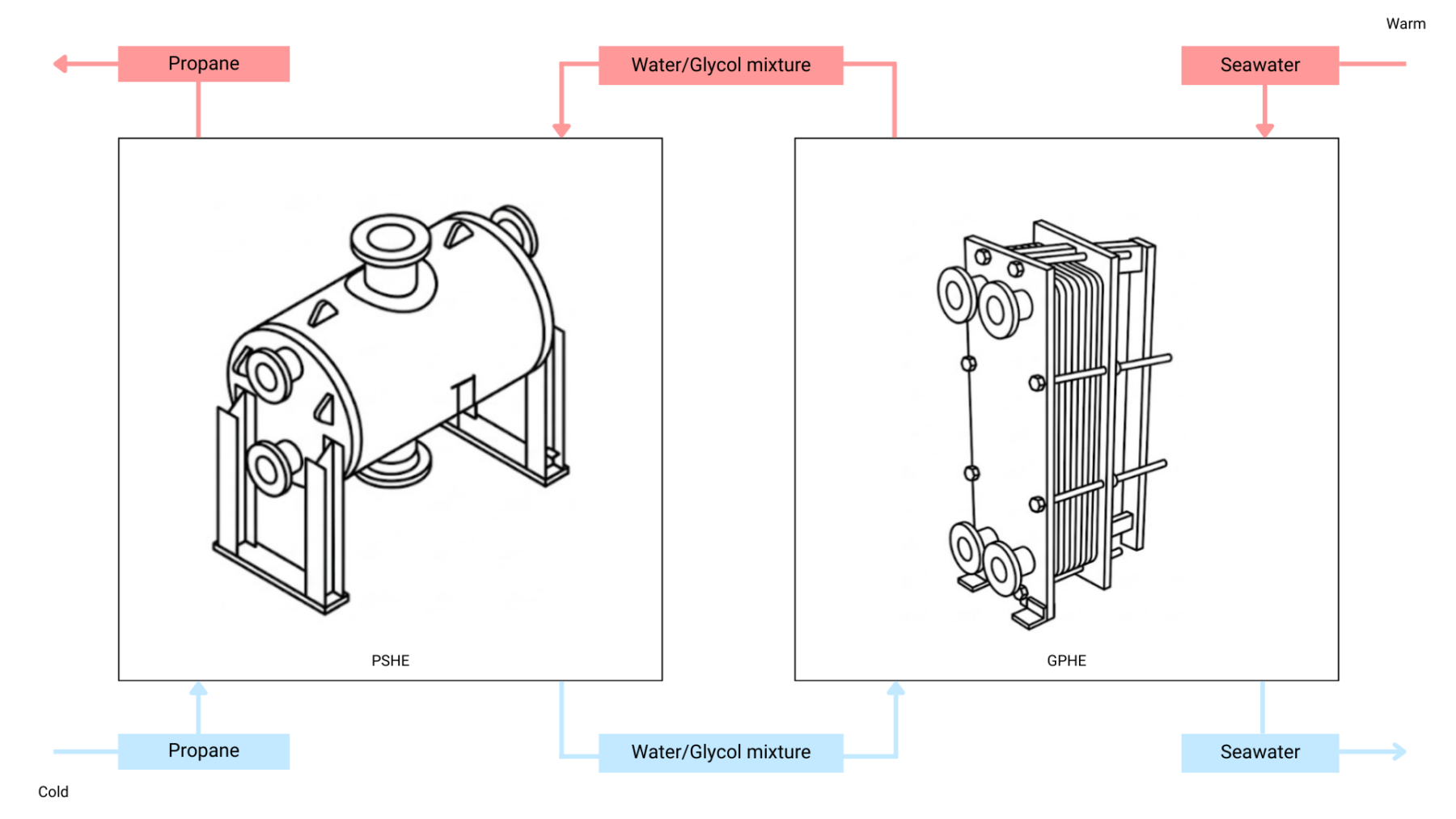
In our customer’s process, the glycol cools down to -4°C. In a Kelvion Gasketed Plate Heat Exchanger (GPHE), we heat this glycol/water mixture with seawater back to around 4°C. Thanks to its salt content, seawater does not freeze at low temperatures, which means it can still be used in cold conditions.
Step 2: Controlled heating of propane
Next, a Vahterus Plate & Shell Heat Exchanger (PSHE) transfers the heat from the glycol/water mixture to the liquid propane. During this process, the temperature of the propane rises from -43.2°C to -5°C, which is exactly within the desired parameters.
Together, these steps form a closed, stable energy loop: an efficient glycol circuit that continuously transfers heat. The key here is “indirect.” Because the seawater and propane never come into direct contact, the process remains safe and fully controllable. Even under extreme conditions, the system stays stable. Freezing is prevented, and temperature fluctuations are minimized.
A clever detail: the heat exchangers are coated in a dark material that absorbs additional heat from solar radiation. This isn’t a major modification, but a smart optimization that further boosts efficiency. Of course, the coating is fully resistant to the low process temperatures.
The result: simplicity in complexity
- Lower operating costs
- 75% reduction in CO₂ emissions
- Less dependence on fossil fuels
- A more stable and safer process
Where natural gas used to be the driving force, seawater is now the silent engine behind the heating process. A solution that shows that innovation is not always about more energy, but about using what we have more intelligently.